
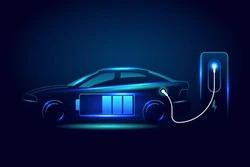
Electric vehicles (EVs) have gone from a niche market to a mainstream transportation choice. With automakers investing billions in battery technology and governments incentivizing EV adoption, the number of electric cars on the road is growing every year. But with this new technology comes a set of forensic challenges that differ significantly from those involving conventional gas-powered vehicles.
At Garrett Forensics, our team has seen first-hand how EV-specific factors—like battery chemistry, charging systems, and high-voltage architecture—impact accident reconstruction, fire origin analysis, and product liability investigations. The complexity of these cases demands a deep understanding of both electrical and mechanical engineering, along with expertise in fire science and accident biomechanics.
The Unique Forensic Challenges of EV Cases
1. Battery Chemistry and Fire Risks
The heart of every EV is its battery pack, typically made of hundreds or thousands of lithium-ion cells. These cells pack tremendous energy into a compact space, but they can fail under certain conditions.
Manufacturing defects such as microscopic contaminants, poor welds, or separator flaws can cause internal short circuits.
Collision damage may puncture a cell or crush internal components, leading to instability.
Thermal runaway—once one cell overheats, it can spread rapidly to others, creating a chain reaction that’s extremely difficult to stop.
From a forensic perspective, battery fire investigations are challenging because the intense heat can destroy key evidence. Investigators must act quickly to preserve damaged cells for analysis, document burn patterns, and differentiate between fire damage caused by the crash and fire damage that may have caused the crash.
2. High-Voltage Systems
EVs operate on high-voltage systems, typically between 400 and 800 volts, which power the motors, inverters, and onboard charging circuits. These voltages are far higher than those in conventional vehicles, and they require specialized knowledge to inspect safely.
In forensic analysis, attention is given to:
Inverters and motor controllers — Failures here can cause sudden power loss or erratic vehicle behavior, which may be relevant in crash causation.
Cooling system malfunctions — Liquid-cooled battery packs and inverters rely on pumps, radiators, and sensors; any failure can lead to overheating.
Wiring and connectors — Corrosion, poor crimping, or insulation breakdown can cause dangerous arcing or loss of power.
Because these components may still retain dangerous voltage after an accident, experts must follow strict safety protocols during inspections.
3. Charging Station and Equipment Failures
While EVs charge at home, at work, and at public stations, not all charging environments are equal. Forensic engineers often investigate:
Connector wear and corrosion — Especially in high-use public chargers, leading to overheating or intermittent charging.
Overheating at the plug interface — Poor connections or damaged pins can generate enough heat to melt components.
Electrical faults in charging stations — Failures in breakers, wiring, or software control systems can cause unsafe charging conditions.
Improper installation — Violations of electrical codes can create hazards even in brand-new facilities.
When fires or failures occur during charging, the forensic challenge is determining whether the fault originated in the vehicle, the charging station, the power supply, or operator error.
Accident Reconstruction with EVs
Crash reconstruction involving EVs must account for characteristics that differ from traditional vehicles:
Weight distribution — With heavy battery packs mounted low in the chassis, EVs have a low center of gravity, which generally improves stability but increases mass-related impact forces.
Regenerative braking — Unlike traditional friction braking, regenerative systems can slow the car significantly without brake light activation, potentially contributing to rear-end collisions.
Quiet operation — At low speeds, EVs produce less noise, which can be a factor in pedestrian and cyclist accidents.
Event Data Recorder (EDR) downloads are particularly valuable, as EVs may store additional data points—such as battery temperature and state of charge—that can provide clues to pre-crash conditions.
Why Multidisciplinary Expertise Matters
Few cases involving EVs can be solved by a single discipline. A thorough investigation may require:
Electrical engineers to evaluate battery packs, wiring harnesses, and charging systems.
Fire investigators to determine ignition sources and follow NFPA 921-compliant methodologies.
Mechanical engineers to assess crash damage, vehicle dynamics, and safety system performance.
Biomechanical experts to analyze whether forces in the crash align with claimed injuries.
By combining these skill sets under one investigative umbrella, Garrett Forensics ensures no aspect of the evidence is overlooked, and all conclusions are defensible in court.
For Attorneys and Insurers: What’s at Stake
EV-related cases often involve higher costs and more parties than conventional vehicle cases:
Repair costs — Battery packs can cost tens of thousands of dollars to replace, sometimes leading to total loss declarations even in moderate accidents.
Liability complexity — Responsibility could rest with the automaker, battery manufacturer, charging station operator, electrical contractor, or even software provider.
Public safety implications — Inaccurate conclusions can lead to unnecessary recalls or missed opportunities to address genuine safety hazards.
A precise, methodical forensic investigation can clarify liability, reduce litigation risk, and ensure fair claim resolution.
Conclusion
As EVs transform our roads, they are also reshaping the way forensic investigations are conducted. High-voltage systems, advanced battery chemistry, and networked charging infrastructure demand specialized expertise. Whether the case involves a battery fire, a charging station malfunction, or a complex crash reconstruction, Garrett Forensics brings the multidisciplinary skill set needed to answer the most critical question: What really happened?
Recent Posts
- How Infotainment Data Helps Investigators Solve Vehicle Theft, Uncover Criminal Activity, and Expose Insurance Fraud
- Vehicle Control History (VCH): An Essential Tool in Modern Accident Reconstruction
- The Science of Occupant Ejection: Why Accident Reconstruction and Biomechanics Must Work Together
- Examining Crush Damage
- Luxury Vehicle Insurance Fraud
Leave a Reply